
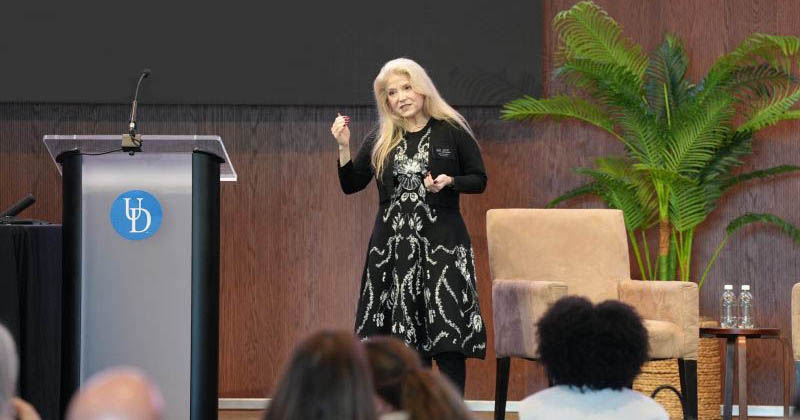
Instructor Nancy Dibert on shifts in social media, authenticity and teaching what matters
Nancy Dibert has watched social media evolve from an experiment into a defining force in marketing, and she was there from the start.
“You know that line from Hamilton about wanting to be in the room where it happens? I was literally sitting at the table when we came up with the hashtag #NetDE for the first time,” she said.
In Twitter’s early days, Dibert was part of Delaware’s emerging social media community. Many users connected through #NetDE, a hashtag created to help Delawareans share news, events and conversations across the state, and often gathered at in-person “tweetups.” Those experiences gave her a front-row seat to the ways social media was beginning to change how people networked, shared information and built communities.
Today, Dibert serves as the CEO of Epic Marketing, an 18‑year‑old full‑service marketing and advertising firm that works across traditional and digital platforms. She is also the program director and instructor for digital and social media marketing courses at the University of Delaware’s Division of Professional and Continuing Studies (UD PCS) and the founder of the Epic Collaborative Foundation, a Delaware nonprofit that supports small businesses and nonprofits in driving economic development.
Her social media perspective was shaped by watching major moments unfold online. She saw events like Hurricane Katrina as early indicators of how people were starting to turn to digital spaces for information and then saw Twitter — and later global events like the Arab Spring — make that shift unmistakable.
“I was getting better, faster updates from this thing called Twitter than I was anywhere else,” she said. “Watching that evolve over time, it was a real turning point.”
For Dibert, it felt like witnessing a transformation in real time.
“I could see this whole metamorphosis happening,” she said. “It was a paradigm shift in how we communicate and how we think about marketing. Communication is at the core of everything we do, so that’s what really drew me to it.”
What interests her now is not novelty but correction. After years of highly produced content and automated tools, she sees audiences pushing back.
“We are shifting from production‑heavy to authentic,” Dibert said. “Unpolished. Real. We can tell immediately when something is fake.”
The limits of artificial intelligence in marketing
She is direct about the rise of one‑click content tools and generative visuals.
“You can tell when someone just pushed a button,” she said. “You are showing people that you do not care. That you are phoning it in.”
Dibert does not reject AI outright. She uses it and teaches it, with limits.
“AI is a huge shift for strategy and for reaching the right people,” she said. “But not for creative. Your creative has to stay ‘you.’ It has to stay human.”
Teaching authenticity in practice
That philosophy carries directly into how she designs her courses. Students do not just learn concepts. They build campaigns.
“They create the copy, the imagery, the video and the calls to action,” she said. “And then they get my feedback.”
Students submit work, and Dibert’s feedback is detailed and candid.
“They are getting an expert’s real weigh‑in on what they are producing,” Dibert said. “Not theory. Not templates.”
Students also receive six months of access to Sprout Social, a widely used social media management platform.
“That is the gold standard,” she said. “If you can use Sprout, employers know you can learn anything else.”
For students who do not have access to social media accounts through work, Dibert removes that barrier. Her connections allow students to gain real-world experience while supporting community organizations like the Wilmington Flower Market and the Dickinson Theatre Organ Society.
“I have nonprofits in my back pocket just for this,” she said. “If a learner doesn’t have a viable organization to use for the course, I’ve got that covered for them.”
Asked about the most challenging part of the courses, Dibert points to accountability.
“They are asynchronous, so you have to hold yourself accountable,” she said. “That can be hard.”
The payoff is practical experience and confidence.
“If they are working, it can be for their employer,” she said. “If they are not, the course can help them build a portfolio.”
Let’s do a “Woof Off”
Dibert’s favorite social media campaign also reflects her belief in authenticity. In 2014, Epic Marketing worked with a Seattle credit union during the Seahawks’ Super Bowl run. Fans were invited to post photos as the team’s “12th Man,” a nickname for the Seahawks’ famously devoted fan base. One person dressed up their dog instead.
“So we said, let’s do a ‘Woof Off,’” Dibert said.
The audience voted. Gus the Pomeranian won.
“It got picked up by radio, local television and even mentioned during the game,” she said. “It grew legs.”
The campaign won a national Diamond Award from the Credit Union National Association.
“That one was my favorite because it was organic,” Dibert said. “It just happened.”
Authentic engagement
Her teaching is grounded in organic, authentic engagement.
“The best campaigns respect the audience,” she said. “They listen. They respond. They let things happen.”
After nearly two decades in the field, Dibert embraces her role as both practitioner and teacher.
“We are training the next generation,” she said. “We owe them honesty.”
For Dibert, the work has never been about chasing trends.
“It has always been about communication,” she said. “That part has not changed.”