
The UD Montessori Teacher Academy model builds a close-knit community of educators
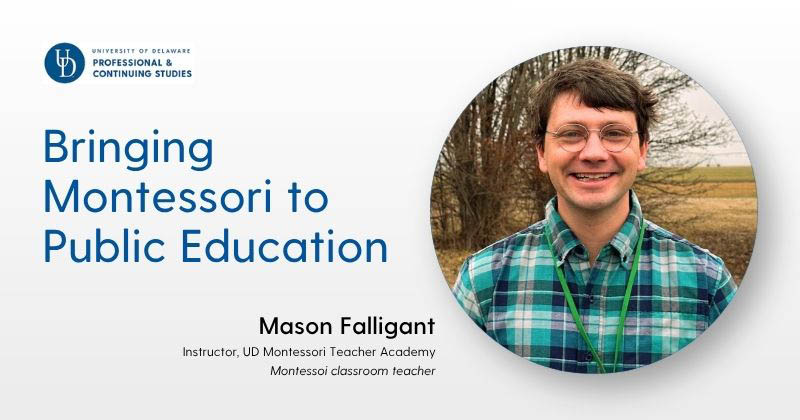
For Mason Falligant, Montessori education was more than a teaching method. It was a mission shaped early and strengthened over time in public school classrooms.
“I went through Montessori from primary through sixth grade,” he said. “It was such a profoundly impactful experience.”
That foundation stayed with him. When he transitioned to a traditional public school system as a middle school student in Birmingham, Alabama, he began to notice what was missing.
“My Montessori experience allowed me to see a lot of the things that I felt were wrong or that could be improved in the public system,” he said.
He carried those observations into his career. As a Montessori teacher at Sussex Montessori School and an instructor with the University of Delaware Montessori Teacher Academy, Falligant worked to close those gaps and expand access to Montessori education in public settings.
The residency model
His path into the program reflected that same purpose. The University of Delaware Montessori Teacher Academy offers a two-year, school-based model that blends seminars, coaching and site visits while preparing teachers for certification. It also partners with schools looking to recruit and train new educators alongside those seeking credentials.
For Falligant, one aspect stood out immediately.
“I think it’s really unique, the residency model that we have,” he said. “We were going through the training with our cohort members who were colleagues within the same school.”
That experience felt different from other programs. Many, he said, bring together participants from across the country, often in virtual settings with little shared context.
“A lot of training programs have residents from all over the country,” he said. “One of the things that’s really unique about the academy is it’s a small but close-knit community of schools.”
That sense of community carried into the classroom. Teachers trained together. They planned together. Over time, that shared experience translated into stronger alignment.
“It makes it really nice to have alignment with the other teachers in our building, knowing we’ve all gone through the same program,” Falligant said.
The residency also kept the work grounded. Because candidates trained in Delaware schools, they could immediately apply what they learned.
“It allows us to really focus on the local needs and marry Montessori to Delaware standards,” he said. “That makes it much more applicable and allows us to apply everything we’re doing to what we’re doing in public education.”
Expanding access
That connection between theory and practice shaped his own development. It also influenced his work as an instructor, where he supported other educators as they moved through the same process.
“Being able to teach the adults who teach children also allows you to widen your scope and impact a little bit,” he said.
The result was a kind of ripple effect. One cohort becomes the next foundation. Each trained teacher carries the work forward.
Even with years of Montessori experience, Falligant found the training transformative.
“One of the things they always say about Montessori training is not just the content knowledge, but the spiritual transformation of the teacher,” he said. “It’s really about helping teachers embody and embrace the Montessori philosophy.”
For him, that transformation was not about learning the basics. It went deeper.
“I was already familiar with how to present a lot of the materials,” he said. “But my adherence to the philosophy and my passion and love for Montessori grew so much through the program.”
He pointed to the instructors as a key influence.
“So much of that came from the enthusiasm of our instructors and the way that they modeled things for us in training,” Falligant said.
That modeling reflected the realities of public education. The program supported teachers in applying Montessori in ways that met the needs of their students and communities.
“Having a training program that understood us as public school teachers and understood the students we serve was incredibly helpful,” he said.
Montessori, he believes, offers more than a method. It opens possibilities.
“It opens up just an incredible number of doors,” he said.
Those doors represent more than professional growth. They signal access, equity and opportunity for students who may not have encountered Montessori otherwise.
By bringing Montessori into public education and helping prepare other educators to do the same, Falligant contributed to a wider shift, one classroom at a time.