
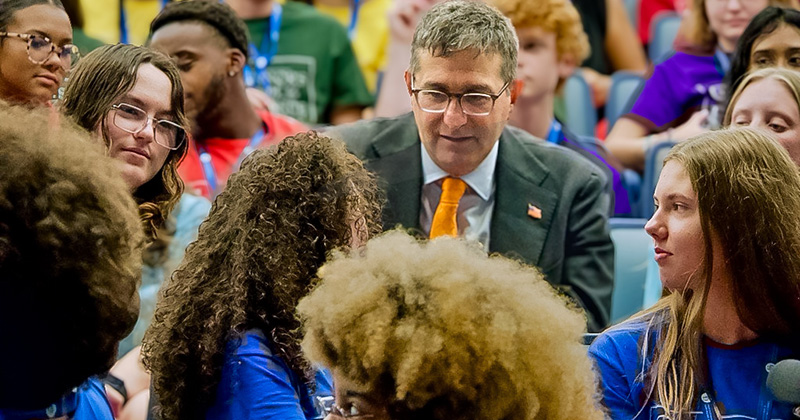
Governor challenged Delaware’s top students to lead, serve and shape the future
One hundred and thirty students at the 2026 Delaware Governor’s School for Excellence had the opportunity to engage directly with Gov. Matt Meyer during a wide-ranging question-and-answer session that touched on healthcare, education, housing, infrastructure, the arts, environmental protection and civic leadership.
For Meyer, the visit was a homecoming of sorts.
Meyer is the first Delaware governor to have attended the Delaware Governor’s School for Excellence as a student. After completing 10th grade, he spent a week in the program, an experience he said remains vivid decades later.
He recalled hearing then-governor Mike Castle speak to his Governor’s School class and remembered having several questions he wanted to ask. But like many students facing a public official for the first time, he was too nervous to raise his hand.
“I remember I had a few questions. I don’t remember what the questions were. I remember I was too nervous to ask them,” Meyer said. “So, my friends and I ended up making fun of the kids who did ask questions.”
The comment drew laughter from students, but Meyer quickly turned the story into a lesson.
“Don’t do that with me,” he said. “Whether you agree or disagree with me, I think it’s really important to our state, to our community, to our future, that we get constructive conversation and dialogue.”
Meyer said those conversations are especially important at a time when many Delaware families are struggling with rising costs and economic uncertainty. One of the issues weighing most heavily on him as governor, he said, is the growing strain working families face in trying to build stable lives.
He described what he called a basic social contract: the belief that people who study hard, work hard and play by the rules should be able to support a family, afford a home and create opportunities for their children.
Increasingly, he said, Delawareans feel that promise is slipping away as the costs of housing, childcare, healthcare, energy and higher education continue to rise.
“What I hear from more and more people across our state is this sense that basic social contract is disappearing,” Meyer said.
The governor challenged participants to think about their responsibilities as future leaders.
“With this Governor’s School comes an obligation,” Meyer said. “Find people who are left out and left behind and do whatever you can to help.”
The remarks set the tone for a candid, student-driven discussion on some of Delaware’s most pressing challenges, with participants posing thoughtful questions and proposing potential solutions.
Students tackle real-world challenges
Students quickly demonstrated the depth of their preparation, raising questions that ranged from healthcare access and educational opportunity to environmental sustainability.
A student opened the discussion with a question about barriers to preventive healthcare for low-income families. Meyer highlighted efforts to expand medical services in underserved communities, including a planned Delaware medical school and workforce initiatives aimed at increasing access to care.
“We need to say that everybody, as a matter of right, should have access to healthcare,” Meyer said.
Arts education generated several questions from students in dance, music and visual arts programs.
One student asked how Delaware plans to address shortages of dance educators and expand arts opportunities in public schools, arguing that arts programs are as valuable as traditional academic subjects.
Meyer said schools have increasingly emphasized reading and math assessments, often at the expense of arts programming.
“We need to make sure our schools educate people holistically,” he said.
Drawing on his experience as a middle school math teacher, Meyer joked that competing with music and dance classes for students’ attention was never easy.
“I’m trying to teach them the slope of a line, and all my students would be dancing to the beat from the music class across the hall,” he said.
Students also raised concerns about unequal access to arts opportunities across the state. One student noted that some schools offer specialized strings programs while others do not, prompting discussion about educational equity and resource allocation.
Meyer pointed to teacher salary increases of more than 15 percent during his first 18 months in office and highlighted recent investments in arts initiatives, including a municipal arts fund and a state arts endowment designed to provide ongoing support for creative programming throughout Delaware.
Planning for growth
Infrastructure and population growth emerged as another major topic. Students asked how Delaware plans to accommodate growth while maintaining transportation systems, schools, housing and energy infrastructure.
Meyer said Delaware’s affordability and quality of life continue to attract new residents, creating both opportunities and challenges.
He emphasized the state’s commitment to “smart growth,” an approach that balances development with environmental preservation and long-term planning.
“We’re not just thinking about next year,” Meyer said. “We’re thinking a lot about 2050.”
Students also raised concerns about school overcrowding and shifting enrollment patterns, prompting discussion about future educational investments.
Meyer said the state is examining how resources can be allocated to address changing enrollment patterns while maintaining educational quality and safe learning environments.
Housing, climate and quality of life
Housing affordability, homelessness and environmental sustainability were also recurring themes.
Meyer described housing affordability as largely a supply-and-demand challenge and said the state is working to increase housing availability while avoiding uncontrolled suburban sprawl. He also highlighted the Hope Center model, which combines housing, workforce and supportive services for vulnerable residents.
Students also asked about protecting coastal communities from sea-level rise and preserving wildlife habitat amid continued development. Meyer said Delaware is developing long-term resilience strategies and strengthening protections for environmentally sensitive areas, particularly wetlands and other habitats that help support wildlife and manage flooding.
“We are working on an infrastructure plan that’s going to take probably over a decade to build out,” he said.
Student advocacy in action
A student also raised concerns about youth vaping and marijuana use. Meyer emphasized prevention and education efforts and pointed to the appointment of Delaware’s first surgeon general as part of a broader public health strategy.
He said the role will help provide trusted health information to Delaware residents at a time when misinformation and conflicting messages can make it difficult for young people and families to make informed decisions.
One of the most thoughtful exchanges of the session came from an arts student who proposed using music, dance and visual arts programs to support young people experiencing homelessness, mental health challenges and social isolation.
The student argued that the arts often provide “a place to find solace and community” during difficult times and suggested that arts programming could play a greater role in helping vulnerable youth build connections and resilience.
Meyer praised the idea and encouraged further exploration of how creative programs can support mental health and well-being.
A conversation about leadership
Throughout the discussion, Meyer repeatedly returned to a central theme: public service.
He described growing concerns among Delaware families about the costs of housing, childcare, healthcare and energy, but also emphasized that talented young people have a unique opportunity to help address those challenges.
For the Governor’s School students gathered in the room, the session offered more than access to Delaware’s chief executive. Students challenged the governor on healthcare, housing, education, environmental protection, infrastructure and public health, often backing their questions with research and policy ideas of their own.
Decades after attending Governor’s School as a student himself, Meyer returned as Delaware’s governor with a message centered on service and civic responsibility.
“With this Governor’s School comes an obligation,” Meyer told participants. “Find people who are left out and left behind and do whatever you can to help.”
Judging by the depth of the questions and ideas shared throughout the session, many students already appear ready to accept that challenge.
Learn more about the Delaware Governor’s School for Excellence at pcs.udel.edu/govschool.