
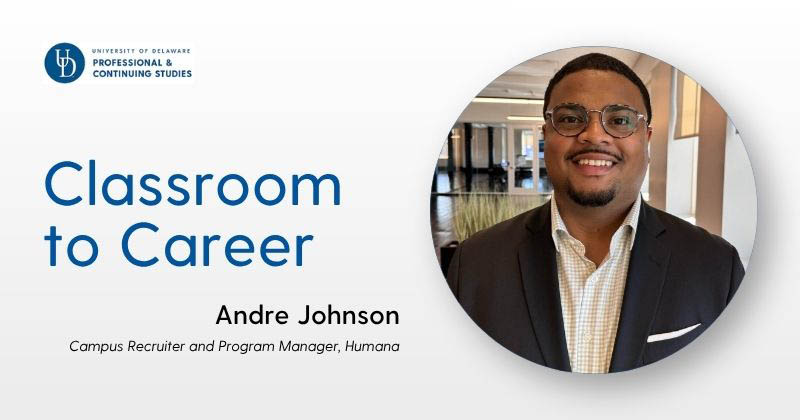
Andre Johnson put his project management skills to work right away
As talent acquisition professional Andre Johnson stepped into a new role, he needed more than theory. He needed tools he could use right away.
The Project Management Certificate through the University of Delaware’s Division of Professional and Continuing Studies (UD PCS) delivered exactly that, helping him bring structure, clarity and confidence to his work from day one.
“My day to day isn’t fully project management, but the foundational pieces completely changed how I think about my work and how I approach programs,” Johnson said. “There were tools I was able to apply almost immediately. We’d have class Wednesday night, and by Thursday morning my wheels were already turning about how I could use them in my new role.”
Applying skills through real-world collaboration
One of the most valuable parts of the course was the group project, which brought together professionals from different industries to tackle a shared challenge. His team worked on a fictional nonprofit called “Have a Heart,” developing a project plan to better serve families affected by catastrophic events. The project required the group to design processes for inventory management, partnerships and volunteer coordination, giving Johnson hands-on experience applying project management principles in a purpose-driven setting.
Instructor Ryan Crawford said the group experience is intentionally designed to reflect the realities of working on cross-functional teams. Participants collaborate with peers from different industries and backgrounds, navigating varied perspectives while working toward a single goal.
“Students often come in hesitant about group work, but by the end of the course, it becomes one of the most valuable parts of their experience,” Crawford said. “The project pushes them to apply what they’ve learned while working with professionals who bring different communication styles, perspectives and approaches.”
Early in the process, teams establish shared expectations and working norms, creating a foundation for effective collaboration throughout the course.
“Creating that structure up front is critical,” Crawford said. “It gives students a practical way to see how strong teams operate and how project organization supports collaboration.”
For Johnson, the experience reinforced how much perspective matters in team environments.
“Collaborating with professionals from other industries gave me a completely different perspective,” he said. “You start to see how project management looks in different spaces and how much you can learn from one another.”
Learning designed for immediate impact
The course format is designed for working professionals, blending live virtual instruction with breakout sessions that encourage discussion and collaboration. Johnson said those conversations kept him engaged and helped him build connections with classmates balancing careers, families and coursework.
He also credited Crawford with creating an environment where concepts were consistently tied to real-world application.
“The benefit of a live class is the real-time interaction between the students and me,” Crawford said. “We cover core methodologies, but I encourage students not to lead with methodology. Instead, we focus on how it shows up in practice — what I often describe as ‘by the book’ versus ‘by practice.’ Drawing on real-world examples and students’ own experiences helps them apply what they’ve learned immediately.”
Building on a strong foundation
Looking ahead, Johnson sees the certificate as a starting point for continued growth. While he does not plan to move into a full-time project management role, the skills he gained are already shaping how he approaches programs and collaborates with others.
“Ryan and I talked a lot about where I’m headed and what makes sense right now,” he said. “Because my focus is still on talent acquisition, pursuing my SHRM Talent Acquisition Specialty Credential is the right next move for me.”
Offered by the Society for Human Resource Management, the SHRM Talent Acquisition Specialty Credential focuses on advanced recruiting strategies, including sourcing talent, improving candidate experience and aligning hiring practices with organizational goals. It builds deeper expertise in talent acquisition while complementing broader HR and leadership skills.
After that, Johnson plans to revisit the Certified Associate in Project Management (CAPM).
“The project management foundation will still be there,” Johnson said. “I see it as something I can continue to build on as my role evolves.”
Continuing the journey
For Johnson, the experience highlights the value of practical learning at the right moment.
“I really enjoyed the course,” he said. “It gave me tools I’ll keep using, and it changed how I approach my work moving forward.”
Originally from Maryland, Johnson came to UD as an undergraduate student in 2006 and graduated in 2010, making the decision to return for professional education an easy one. As he explored project management training options, UD PCS stood out for its flexibility, live instruction and real-world focus.
“I liked the idea of being virtual but still live,” Johnson said. “Being able to engage with the instructor and learn alongside professionals from different industries made a big difference.”
For Johnson, returning to UD also meant reconnecting with a learning environment he already trusted, one that fit his career goals and his life as a working professional in Delaware.