
Engineer the Future of Mobility
For high school students, 15 and up, interested in engineering, robotics, AI, computer science and programming
Only 6 seats left. Secure your spot before the June 22 deadline.
July 6–10, 2026
University of Delaware | ICAT Lab at STAR Campus, Newark, Del.
Autonomous vehicles are transforming how the world moves — and the engineers designing them are shaping industries far beyond transportation. The Autonomous Driving Academy invites motivated high school students to explore the engineering principles, systems thinking and technologies behind modern self-driving systems.
Designed for rising high school sophomores, juniors and seniors (ages 15+), this five‑day, hands‑on program is ideal for students interested in engineering, robotics, AI, computer science and programming who want to go beyond the basics.
Students gain:
- A strong foundation in engineering and autonomous systems
- Teamwork, communication and analytical skills
- Exposure to a college-level research environment
- Project-based experience that supports college and internship applications
Wondering if this program is right for you? Share your interests and experience through the form below.

About the program
Developed with University of Delaware’s Connected and Autonomous Research Laboratory (CAR Lab) and the Department of Computer and Information Sciences, this program focuses on how engineers design, integrate and test real-world autonomous systems.
More than a coding camp, this program emphasizes:
- Engineering design and systems integration
- How software, sensors and control systems work together
- Applying theory to real-world challenges
Learn from a leader
The program is led by Weisong Shi, a globally recognized and highly cited researcher in connected and autonomous vehicle technologies, and director of UD’s CAR Lab.
Students learn from researchers at the forefront of the field, gaining insight into both how autonomous systems work and how engineers approach complex, real-world problems.
Engineering in practice
Participants gain applied experience working with industry-relevant tools and technologies, including:
- Robot Operating System (ROS)
- Python and C++
- Sensor integration, perception and control logic
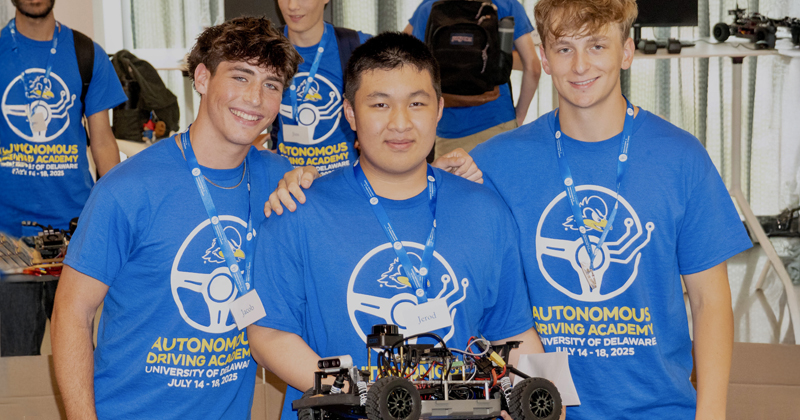
Working in teams, students design and refine autonomous driving behaviors, applying engineering concepts step by step to solve real-world constraints. The week culminates in an engaging final challenge where student-built systems navigate real-world-inspired scenarios.
Program Details
Autonomous Driving Pre-College Summer Program — Noncredit Program
Only 6 seats left. Secure your spot before the June 22 deadline.
LOCATION: ICAT Lab at STAR Campus, University of Delaware, Newark, Del. Housing is not provided; rooms can be reserved at the Baymont by Wyndham Newark I-95 at University of Delaware at a special group rate. At least one guest in each room must be 21 or older.
SCHEDULE: July 6-10, 2026, 9 a.m.-4 p.m., Monday-Friday
PRICE: $2,500, all materials included. Discounts are available for dependents of military and veterans, UD employees and UD alumni, or two or more siblings from the same family.
REGISTRATION DEADLINE: June 22
NONCREDIT CONTACT HOURS: 3.0 CEUs | 30 noncredit contact hours
TECHNOLOGY REQUIREMENT: Students must bring their own laptop.
LUNCH: Students should bring their own lunch for the first four days of the program. Lunch is provided on the final day of the program.
Financial options available
Only one discount or scholarship award can apply per registration.
Registration by June 22 is required to order supplies.
DISCOUNTS: A 15% discount is available for dependents of military and veterans, UD employees and UD alumni, or two or more siblings registering from the same family. For details or to receive the discount code, please email continuing-ed@udel.edu.
See the Academy in Action
Get a glimpse of the hands-on learning and collaboration that define the Autonomous Driving Academy. This short video features participants engaging with cutting-edge technology, building skills and exploring real-world applications in autonomous systems.
Recommended experience
The ideal candidates will have a background in robotics and proficiency in Python with some knowledge of coding in C++. Students will be given coding exercises but will not need to code from scratch. Instead, they will receive prompts where they can use resources like Google or ChatGPT for help.
Course outline
Monday
Topics:
- Introduction to the hardware of autonomous robots
- Safety protocols
- Vehicle control fundamentals
- Sensing technologies overview
Activities:
- Assembling autonomous robot kits in groups
- Testing the robot’s control and reading sensor data
Tuesday
Topics:
- Autonomous driving system fundamentals
- Programming tools overview: ROS, Python, C++
- Key autonomous driving functions: mapping, localization, path planning
Activities:
- Installation of ROS and autonomous driving packages
Wednesday
Topics:
- Autonomous racing and parking systems
- Optimization techniques for racing, including trajectory optimization and reinforcement learning
Activities:
- Hands-on baseline implementation of autonomous racing application
- Optimization of the baseline implementation
Thursday
Topics:
- Autonomous parking systems
Activities:
- Continuing hands-on optimizing the racing system
- Hands-on autonomous parking system implementation
Friday
Competition Day
Participants will put their knowledge and skills to the test in an exciting, high-energy racing challenge. After four days of hands-on learning, they will race their autonomous vehicles on a track, showcasing their custom-built designs and problem-solving abilities. It’s not just about speed — teams will be judged on the creativity and technical execution of their systems, with the team achieving the fastest time taking home the win! This final event emphasizes real-world applications of autonomous driving technology, providing students with a unique opportunity to see their hard work come to life in a dynamic and competitive environment.
Learner outcomes
Participants in this program will:
- Develop skills in programming tools such as ROS, Python and C++, essential for implementing and troubleshooting autonomous driving algorithms.
- Implement and enhance autonomous parking and racing applications, focusing on performance optimization and efficiency.
- Apply theoretical knowledge in practical, hands-on projects that simulate real-world autonomous driving scenarios.
- Work effectively in teams to design, build and improve autonomous driving systems, fostering a collaborative learning environment.
- Prepare and deliver technical presentations showcasing project outcomes and innovations to an audience, honing communication skills.
- Gain insights into potential career paths in the rapidly growing autonomous driving and robotics sectors.
- Develop critical thinking and problem-solving abilities in a cutting-edge technological context.
- Enhance teamwork, leadership and communication skills through collaborative group projects.
Instructional team
Weisong Shi is an Alumni Distinguished Professor and the chair of the Department of Computer and Information Sciences at UD who founded the Connected and Autonomous Research Laboratory (CAR Lab) at UD in December 2017. Shi is an internationally renowned expert in edge computing, autonomous driving and connected health: His pioneer paper in the field, “Edge Computing: Vision and Challenges,” has been cited more than 7,500 times.
Before joining UD, Shi was a member of the computer science faculty at Wayne State University, where he held multiple administrative roles, including associate dean for research and graduate studies in the College of Engineering and interim chair of the computer science department. From 2013 to 2015, he served as a program director for the National Science Foundation (NSF). Currently, he is the editor in chief of Institute of Electrical and Electronics Engineers (IEEE) Internet Computing Magazine and Elsevier Smart Health. He is the founding steering committee chair of three conferences: the Association for Computing Machinery (ACM)/IEEE Symposium on Edge Computing (SEC), the IEEE/ACM International Conference on Connected Health (CHASE) and the IEEE International Conference on Mobility (MOST). Additionally, he is the general chair of ACM MobiCom ’24, the flagship conference on Mobile Computing and Wireless Networking. Shi is a fellow of IEEE, a distinguished scientist of ACM and a member of the NSF Computer and Information Science and Engineering Advisory Committee and Computing Community Consortium Council.
William He is a fourth-year doctoral student in the CAR Lab. His research is primarily at the intersection of autonomous driving and cyberphysical systems, focusing on building safe and reliable machine learning and simulation environments for autonomous vehicles and autonomous mobile robots. He has collaborated with researchers from Autoware, Ford, Western Digital, Blue Halo, Leidos, the Federal Highway Administration and Oak Ridge National Laboratory.
Arpan Bhattacharjee is a third-year doctoral student in the CAR Lab. His research interests include edge computing for connected and autonomous vehicles (CAVs), software over-the-air (OTA) updates and autonomous vehicle simulation and testing.
Ren Zhong is a doctoral student in computer science, with a focus on mapping and localization for autonomous driving. His research is centered on using crowdsourced data to dynamically update maps, improving both the timeliness and accuracy of mapping systems to develop safer and more efficient autonomous transportation technologies.