
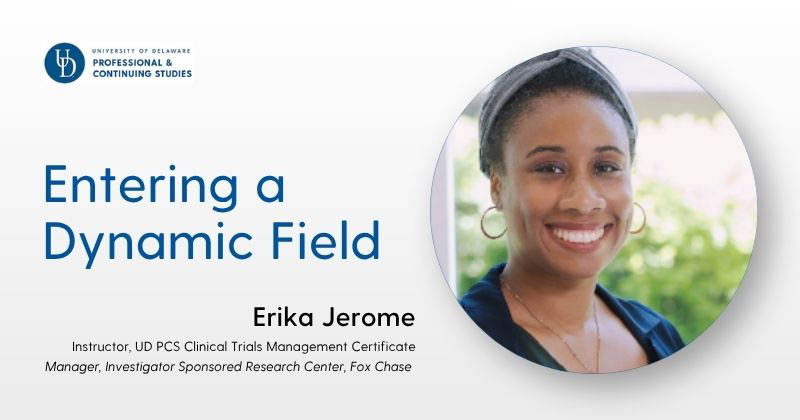
Instructor Erika Jerome brings real-world insight to UD PCS clinical trials management
Erika Jerome’s career in clinical trials management began not with a predetermined plan, but through seizing opportunities, curiosity and a readiness to explore unfamiliar territory.
“I actually wanted to be a lawyer initially,” Jerome said. “I studied political science and sociology, and it was during the 2009 recession that I started looking at other options.”
Her entry-level clinical research role eventually shaped her career. Now, Jerome manages an investigator-sponsored research unit at Fox Chase Cancer Center, drawing on over 10 years of experience in clinical trial management, regulatory compliance and collaboration.
In this role, she oversees protocol development and monitoring teams, ensuring the timely activation and compliance of studies while managing multiple aspects of the research process. She also works closely with physicians, clinical teams and organizational leadership to coordinate efforts and support the successful execution of investigator-sponsored trials in oncology.
“We develop our own studies, write protocols, coordinate budgets and ensure contracts are completed,” she said. “We submit studies to review boards, enroll patients at Fox Chase and, when needed, expand trials to additional sites by collaborating with other cancer centers and academic institutions.”
That breadth of experience now informs her work as an instructor in the University of Delaware’s Clinical Trials Management Certificate program within the Division of Professional and Continuing Studies (UD PCS).
Jerome’s path to teaching was equally unexpected. After receiving a message about the opportunity through LinkedIn, she took time to learn more before deciding to get involved.
“It was something different from what I had going on, and it felt exciting,” she said. “Once I understood the program, it seemed like a great fit.”
Drawing on her professional background, Jerome brings a practical, real-world perspective to the classroom. Her course is designed to introduce students to the full scope of clinical trials management, from sponsor-driven research to work conducted within academic medical centers.
“I think the course provides a comprehensive overview,” she said. “Students are learning about both the sponsor side and the institutional side, which is how many people first enter the field.”
That dual perspective is critical in an industry that is both complex and constantly evolving. Jerome emphasizes that clinical trials management is not a field where learning ever stops.
“It’s a fast-paced environment with a lot of moving parts,” she said. “There are always competing priorities and multiple things happening at once, so it’s a good fit for people who are comfortable working in that kind of environment. You’re always learning. Even after years in the field, I still discover new things all the time.”
Her course reflects that reality by offering content in multiple formats, including readings, videos, guided discussions and direct interaction. This layered approach helps students engage with the material in different ways while gaining a clearer understanding of how the field operates in practice.
“We try to give students a multifaceted experience,” Jerome said. “They can explore different aspects of clinical research and start to figure out what interests them most.”
For some students, that may mean identifying a specific career path within clinical research, such as data management, regulatory affairs or study coordination. For others, the course provides a starting point for further training and certification.
“People often ask how to get into clinical research,” she said. “The reality is that many start in entry-level roles and build from there. This course helps them understand what those paths look like.”
Jerome also notes that the field attracts individuals from a wide range of academic backgrounds. While many professionals begin with degrees in biology or related sciences, others enter through alternative routes, bringing diverse skills and perspectives.
“It’s not always a straight path,” she said. “There are many ways to get into this field.”
That accessibility, combined with the field’s growth and ongoing evolution, makes clinical trials management an appealing option for those interested in health care, research and innovation.
Through her work as an instructor, Jerome aims to give students both the knowledge and confidence to take the next step in their careers. By connecting course content to real-world applications, she helps demystify a complex field and highlights the opportunities within it. She is particularly driven by the opportunity to support the development of new and effective therapies, advancing the science and practice of oncology.
“I want students to come away with a clear understanding of what’s possible,” she said.
For those considering a career in clinical research, Jerome’s journey offers a powerful example of how unexpected opportunities can lead to meaningful work, while her teaching provides a roadmap for navigating a dynamic and impactful field.