
Ready to tell your story? Use special discount code LAUNCHPOD to save $350.
This course is closed for summer 2026. Sign up to get summer 2027 course updates.
Date: June 22–26, 2026, Monday-Friday, 9 a.m. to 4 p.m. 
Location: University of Delaware Main Campus, Newark, Del.
- Hands-on learning: Create a podcast from concept to completion using industry-standard tools.
- Expert guidance: Learn from UD faculty and media professionals.
- Creative collaboration: Work in teams to develop storytelling, research and production skills.
- Recognition: Receive a personalized program reference letter for your college application portfolio, plus a digital badge to display on social media or online profiles
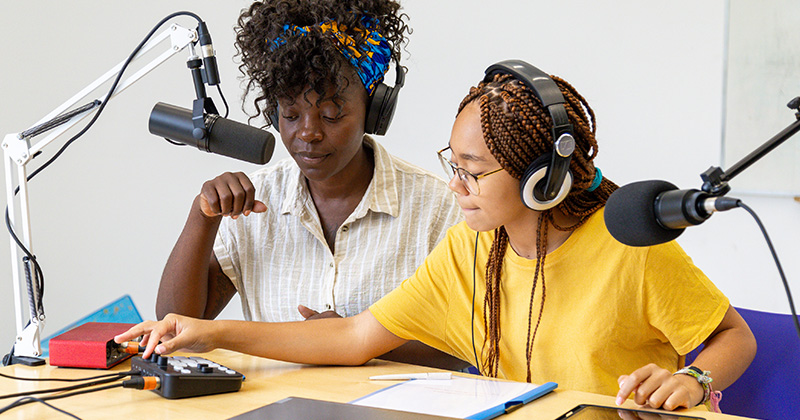
Step into the world of digital storytelling with the Podcasting Pre-College Summer Program, an intensive five-day workshop designed for high school students eager to explore the art and science of podcasting. Offered in collaboration with UD’s Department of English, this noncredit program blends hands-on production experience with creative and technical training, giving participants the tools to create professional-quality podcasts for diverse audiences.
Students will learn the fundamentals of podcasting — from brainstorming and scripting to recording, editing and marketing — while gaining insight into podcast genres, audience engagement strategies and accessibility best practices. Working in small teams, participants will produce a complete podcast episode and promotional trailer by the end of the week.
The program concludes with a student showcase, where participants present their work to peers and families. UD faculty will also share information about academic pathways in media studies, journalism and digital communication.
REGISTRATION AND SCHEDULE
| Podcasting Pre-College Summer Program — Noncredit Program
This course is closed for summer 2026. Sign up to get summer 2027 course updates.
|
PROGRAM DETAILS
Who should participate in this program?
This pre-college program is designed specifically for rising sophomore through senior high school students, 15 and up, who are interested in writing, storytelling, journalism, communication, music, popular culture, digital marketing, debate, web accessibility and multimedia design.
Learner outcomes
By the end of the program, students will be able to:
- Work in teams of three-four to plan, research, record and edit a complete podcast episode.
- Find and evaluate credible sources, including conducting at least one original interview or gathering material to support their topic.
- Use digital audio editing software to produce a polished episode.
- Create a podcast that shows understanding of narrative structure, audience engagement and effective use of audio elements.
- Complete a full production cycle in four days, delivering a finished episode, promotional trailer and visual artwork while meeting daily deadlines.
- Apply accessibility principles such as transcription, clear speech and appropriate pacing.
Course outline
Monday: Foundation and Planning
Topics: Podcast genres, audience analysis, team formation, audio basics
Activities: Icebreaker and team formation (groups of three-four), collaborative brainstorming, topic selection with peer feedback
Tuesday: Research and Content Development
Topics: Research strategies, interview techniques, scriptwriting, narrative structure
Activities: Research workshop, source evaluation, script development, hands-on recording practice
Wednesday: Production and Recording
Topics: Advanced editing, audio storytelling, accessibility principles
Activities: Record complete podcast episodes using refined scripts, editing workshop with music integration, peer review
Thursday: Finalizing and Marketing
Topics: Post-production, promotional material creation, marketing fundamentals
Activities: Final editing, trailer creation (one-minute promotional piece), visual artwork design, marketing copy
Friday: Student Showcase
Topics: UD Department of English academic offerings and opportunities
Activity: Student showcase for parents and guests
Technology requirements
Students must bring their own laptop and be able to download and install free sound editing software. Students will learn basic recording and editing in Audacity before exploring more advanced platforms (e.g. Descript, Ocenaudio, Garageband, etc.). Laptops must have functioning microphones and speakers.
Instructor
Sean Zdenek is an associate professor of technical and professional writing at the University of Delaware. His research focuses on web accessibility, disability studies, sound studies and rhetorical theory and criticism. His book Reading Sounds: Closed-Captioned Media and Popular Culture (University of Chicago Press) won the 2017 Best Book award in technical or scientific communication from the Conference on College Composition and Communication. Zdenek teaches courses in soundwriting, web accessibility, AI literacy, disability studies and technical writing. He attended the National Humanities Center Podcasting Institute for faculty in 2024.
For more information